
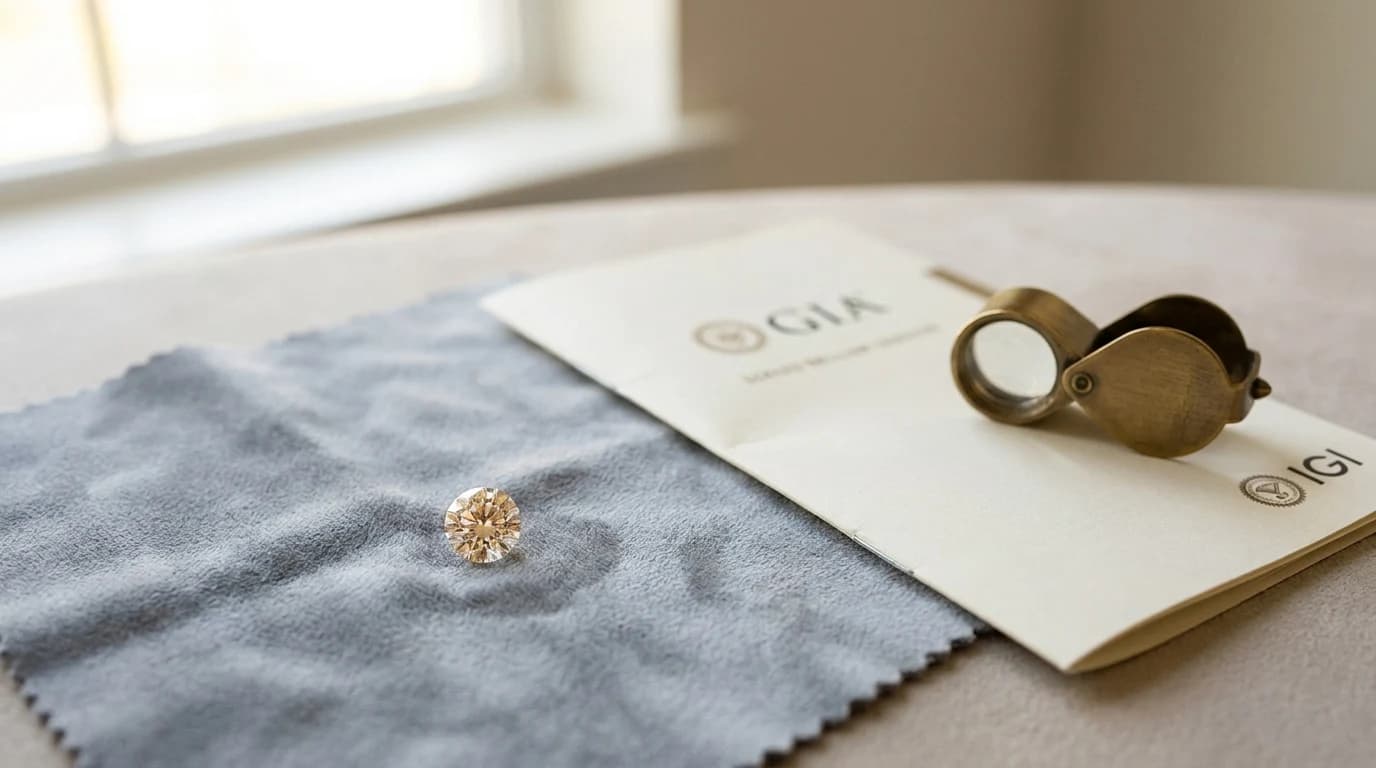
At Kove, you will mainly encounter GIA reports for natural diamonds and IGI reports for lab-grown diamonds. This is a practical guide to our selection, not an exclusive division of the laboratories’ services. The document listed for the particular stone or piece is what matters.
What a report confirms
A gemological report describes the stone or finished piece examined. For an individual diamond, it identifies origin and assessed characteristics; the details depend on the report type. It is not a promise of future value or a resale valuation.
The laboratory name alone is not enough. Compare origin, weight, dimensions, color, clarity, and cut information in the actual documents. Matching four basic grades does not guarantee the same appearance or price.
GIA: mainly natural diamonds in our selection
GIA is a usual choice for a natural diamond at Kove. Its natural-diamond reports describe the 4Cs and other characteristics according to the document type.
GIA also assesses lab-grown diamonds. Since October 1, 2025, its new assessments of D-to-Z lab-grown diamonds use Premium and Standard categories. This is a different format from its earlier detailed color and clarity grading.
The change does not automatically invalidate an older report. Check the date, document type, and laboratory record.
IGI: mainly lab-grown diamonds in our selection
For lab-grown diamonds at Kove, you will most often encounter IGI. Its loose-diamond report records origin and the 4Cs, helping you compare specific stones.
IGI also grades natural diamonds and finished jewelry. An IGI label alone therefore does not mean lab-grown: origin must be stated in the report. There is no reliable general rule that converts every IGI grade into a GIA grade by shifting it one step.
A stone report and a jewelry report cover different things
A report for a center diamond concerns that stone. A Jewellery Report for selected bracelets and earrings describes the finished piece within the scope of that document. It is not a collection of individual certificates for every small diamond.
The exact document type — for example IGI or HRD — is listed for your selected piece. For a pair of earrings, distinguish the total carat weight of the pair from the weight of one stone.
What to check before ordering
Open the report for the selected stone or piece. Check whether it describes natural or lab-grown diamonds and whether it covers one stone or the finished jewelry.
Verify the report number directly in the issuing laboratory’s online registry and compare its details with the listing. If the document records a laser inscription, a professional can help match it to the stone. A missing inscription, or one hidden by the setting, is not by itself proof of fraud.
If the difference between two stones or documents is unclear, send us links to your selection. We can explain the information that applies to those particular options.
GIA, IGI, and HRD: what to check
This is a guide to documents, not a ranking of laboratories or a price guarantee.
| Question | GIA | IGI | HRD |
|---|---|---|---|
| What you encounter at Kove | Mainly natural-diamond reports | Mainly lab-grown diamonds; also jewelry reports | Selected stones or jewelry as listed |
| Lab-grown diamond | New D-to-Z assessments since Oct 1, 2025: Premium / Standard | Origin and 4Cs in the diamond report | Check the specific document type and scope |
| What the document covers | The stone identified in the report | An individual stone or jewelry, depending on report type | The item described in the specific report |
Frequently asked questions
Choose a specific stone, not just a logo
Start with the diamond type and your budget, then check the document for the selected stone or piece. If you need the differences explained, we can help with your particular selection.
Still not sure? Just ask a real person.
Tell us your idea and your budget — we answer personally and spec the best certified diamond for you, with its IGI or GIA certificate. No pressure, no obligation, no checkout.